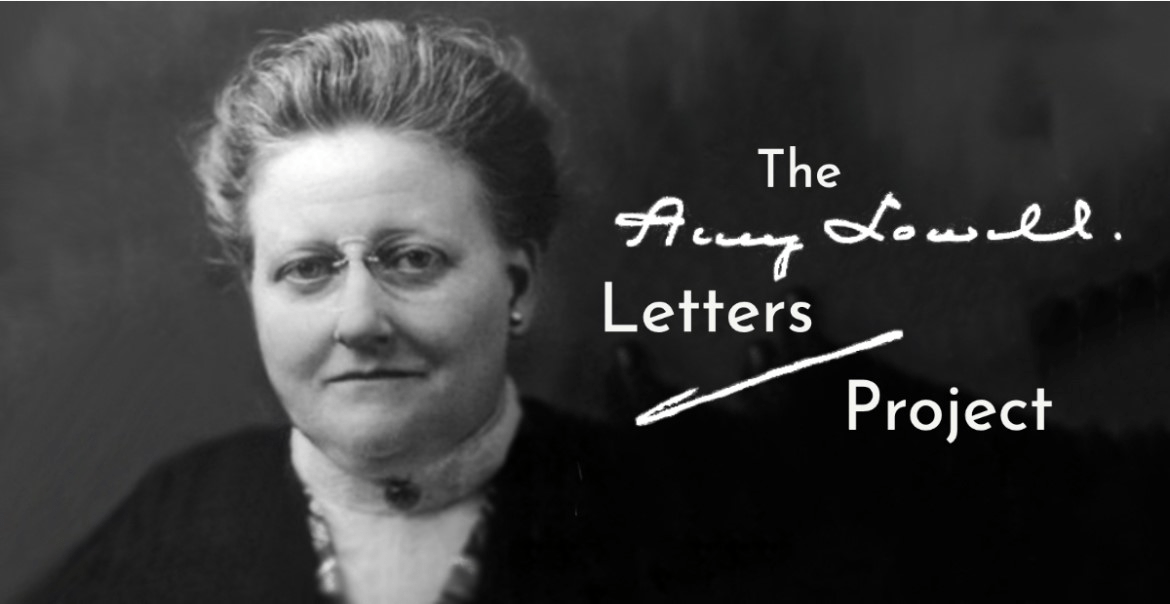
The Amy Lowell Letters Project was awarded a Scholarly Editions and Translations Grant from the National Endowment for the Humanities in their most recent awards cycle. This 36 month, $300,000 award will support the creation of a searchable, open-access, digital scholarly edition of the never before collected letters of American poet, editor, and critic Amy Lowell (1874–1925). Lowell’s letters are archived at Harvard University’s Houghton Library (MS Lowell 19-19.4). With their permission, and with the support of Loyola University Chicago’s Center for Textual Studies and Digital Humanities, we are editing, annotating, doing XML markup (following the guidelines of the Text Encoding Initiative), and digitizing letters related to her career as a powerful, polarizing, and influential figure in American poetry.
At the time of her sudden death in 1925, Lowell was one of the most celebrated and sought-after authors in America, respected both as a poet and as a literary critic. Her opinions on the state of American literature, and her disputes with both conservative academics as well as with avant-garde poets, were well documented in newspapers and magazines. Her books sold so quickly that they typically went into second and third editions before the first edition even landed on bookstore shelves; her lectures and readings drew crowds of thousands. She published prodigiously during her fifteen-year career (1910-1925): six volumes of poetry (three more were published posthumously), two volumes of literary criticism, a two-volume biography of John Keats, and countless articles and reviews. What’s O’Clock, in press at the time of her death, won the 1926 Pulitzer Prize for poetry.
Lowell urged readers to see themselves as informed stakeholders in the New Poetry movement that swept American culture in the first decades of the twentieth century and worked to make poetry accessible and exciting for a broad public. This was the basis of a quarrel with fellow American poet Ezra Pound, who objected to her plans to aggressively market Imagism, the loosely-organized poetic style that initially brought them together, by bringing out an annual Imagist anthology with a major publishing house. He worried this would commercialize modern poetic experimentation and dilute its value as high art. In the short term, Lowell emerged as the victor: the three volumes of Some Imagist Poets (1915, 1916, 1917), published by Houghton Mifflin and featuring poems by H.D. (Hilda Doolittle) and D.H. Lawrence, among others, introduced modernist poetic experimentation to a general readership and turned Imagism into a full-blown poetic movement. Promoting the anthologies in lecture tours, Lowell schooled over-capacity crowds across America in how to read and appreciate Imagism, free verse, and experimental poetry more generally. For many Americans of her era, she was the face of modern poetry.
But ultimately Pound emerged victorious, remembered today as a powerful, if controversial, figure in modern poetry, an impresario who shaped poetic careers and promulgated an explosive new poetics, while Lowell has been wrongly reduced to a derisive footnote, a wealthy woman who tried to buy her way into literary history. The very successes in promoting Imagism that earned her a devoted following of readers and made her a celebrity during her lifetime left her vulnerable to charges that she was less poet than propagandist, an “Amygist,” in Pound’s words, not an Imagist. No representative collection of her letters exists, even though, according to librarians at the Houghton, hers is one of the most accessed and important archives in the library, since she corresponded with virtually all the most prominent writers and publishers of her time. Only a fraction of the thousands of letters documenting her centrality to modern poetry have been published, and only in connection with two other figures: D.H. Lawrence (34 letters in The Letters of D. H. Lawrence and Amy Lowell, 1914-1925, ed. Claire E. Healey and Keith Cushman, Black Sparrow Press, 1985) and Florence Ayscough, Lowell’s collaborator on a book of Chinese translations (44 letters in Florence Ayscough and Amy Lowell: Correspondence of a Friendship, ed. Harley Farnsworth MacNair, University of Chicago Press, 1945). Both books are out of print.
Lowell’s marginalized role in contemporary accounts of literary modernism has been bad for her legacy as a poet: she was a major literary figure whose significant body of work merits attention in its own right. But her erasure has also been bad for literary history: her letters are a gold mine of information related to the New Poetry movement. They show her in conversation with some of the best-known American and European poets of the early twentieth century, discussing, reworking, arguing about works we now take for granted as literary masterpieces. They also show her engaged in equally impassioned conversations with once prominent literary figures whose work is less well known today. Her letters reveal, as well, the depth and complexity of her relationships with behind-the-scenes players whose roles in modernism are similarly underrepresented or overlooked: editors of both little magazines and mainstream popular magazines, heads of publishing houses, newspaper columnists, translators, literature professors, leaders of literary societies, and book sellers. It is no exaggeration to describe Lowell as a nexus in a complex network of literary professionals working at the cutting edge of modernist experimentation.
The goal of The Amy Lowell Letters Project (ALLP) is to make this case by publishing a collection of 1,800 letters over the next six years (900 during the period of this grant, 900 in the following three years) with scholarly annotations and detailed TEI-conformant markup that allow for deep, context-rich reading and robust searching. As a reader’s text and a searchable data set, ALLP will help readers understand–and allow them to trace–Lowell’s professional relationships with other modern poets and the lifecycle of poems and volumes, both hers and those of the many poets she mentored and advocated for. It will offer real-time insights into the publication histories of little magazines, and the mainstreaming of modern poetry in wide-circulation magazines such as The Century and The Atlantic Monthly. It will track the financial transactions subtending modernist poetry (royalties, printing costs, journal subscriptions and sponsorships), and by detailing Lowell’s cross-country lecture tours in support of her volumes and the New Poetry movement more generally, will help trace the outlines of the early 20th century literary lecture circuit.
Where foundational digital projects in literary modernism, such as the Modernist Journals Project, allow users to engage with the New Poetry as early twentieth century readers would likely first have encountered it in magazines and newspapers, Amy Lowell’s letters provide insights into the labor that precedes publication: the queries, submissions, revisions, rejections, and financial transactions that bridge artistic creation and public consumption. The relationships and conversations that emerge in these letters show modernist poetry in formation. Once we have enough TEI encoded letters in place we can start creating network visualizations of Lowell’s relationships, enabling visual studies of her role in the New Poetry.
Lowell’s papers at Harvard’s Houghton Library are uniquely complete because she had secretaries type her professional letters in duplicate, allowing her to build and manage her own archive. (She started saving her letters in earnest around 1913, the year she first traveled to England to meet the poets writing under the mysterious and provocative Imagiste banner.) Two months after Lowell’s death, her longtime companion and literary executor Ada Dwyer Russell wrote to one of Lowell’s closest friends, composer Carl Engel, explaining the significance of the archive: “The files mean a perfect history of the whole poetry movement and we have her answers in carbon to everything she wrote” (Bedford 522).
The Houghton Library has made Lowell’s scanned outgoing professional correspondence free and publicly available through their online library catalog (HOLLIS), their only stipulation about its use being that any projects resulting from the scanned letters must be open access. With over 1,400 unique letter recipients, however, the letters, which are only searchable by recipient names, can be difficult to navigate for researchers unfamiliar with the role of Lowell’s correspondents in transatlantic publishing networks. For example, someone interested in periodical studies might recognize Harriet Monroe, editor of Poetry, A Magazine of Verse in the finding aid, but they are unlikely to know to look in letters to Elisabeth Brown Cutting, associate editor of the North American Review, or Marguerite Wilkinson, poetry editor of the Los Angeles Graphic to learn how the New Poetry circulated in American popular culture through mainstream magazines and newspapers. Through transcriptions marked up in TEI/XML, links to original images on HOLLIS, scholarly annotations of the people, periodicals, publishers, institutions, and events referenced in the letters, and browsing and search capability, The Amy Lowell Letters Project will make Lowell’s professional networks, and the knowledge, data, and resources within her letters available and accessible to researchers and educators working in literary modernism, American poetry, women’s and gender studies, periodical studies, book history, print culture, and media studies.
 melissa bradshaw